
Approach
A demand-driven learning network for circular value chain collaboration
To create a constant dynamic within the learning network, Möbius designed a guidance trajectory with a steady "heartbeat" of regular gatherings. The underlying philosophy was one of continuous zooming in and out: projects were helped, on the one hand, to achieve tangible results within their own scope, and on the other hand encouraged to zoom out toward the broader system.
This was realised through a carefully considered mix of interventions:
-
Kick-offs and networking moments: from the outset, participants were given the tools they needed around complex project management and teamwork, which immediately led to cross-pollination between the different consortia.
-
Thematic four-month cycles: each cycle consisted of a physical, interactive session (collective reflection) followed by a digital moment (collective coaching). We combined insights from experts, practitioner testimonials and peer-to-peer learning, among other things via the CREA method (a structured working format for arriving at solutions through collective intelligence).
-
The content of the sessions was tailored to the needs of the consortia around substantive and process-related themes such as:
-
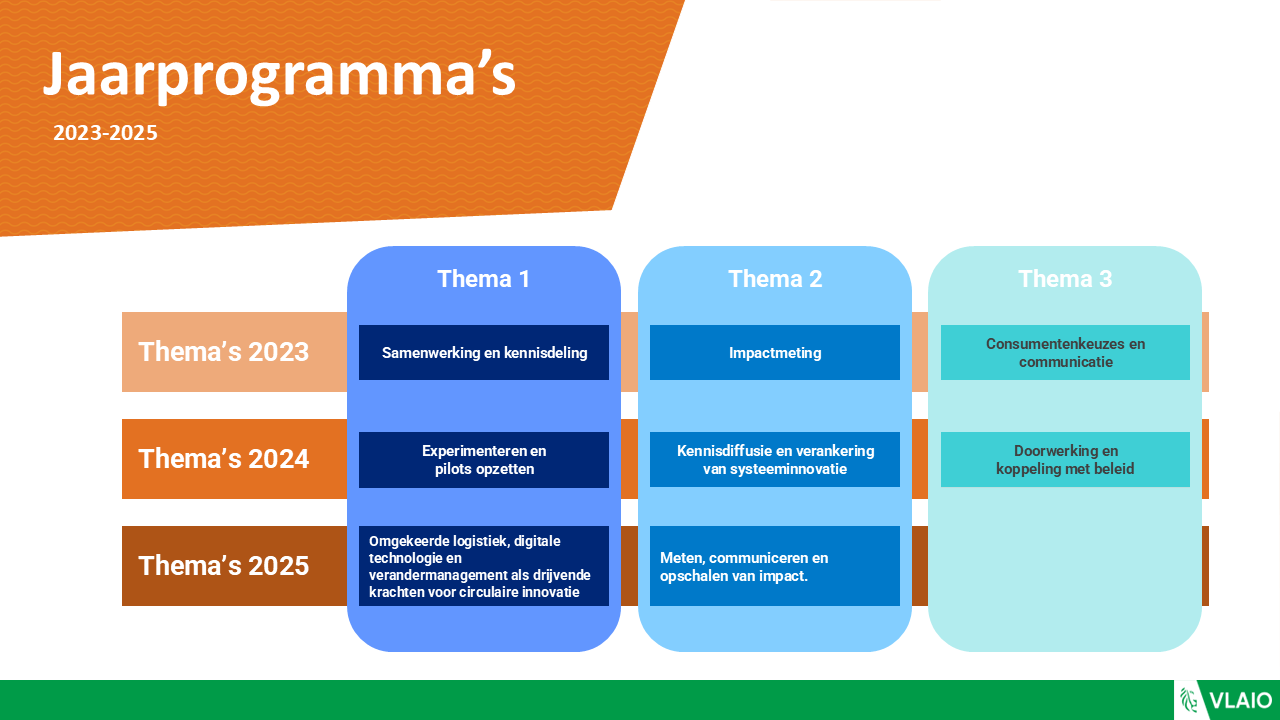
How do you forge powerful partnerships and effectively share knowledge across organisational and company boundaries?
-
How do you make the ecological (CO₂ and materials) and societal impact of circular innovations measurable?
-
Which changes in consumer behaviour are needed, and how do you convince consumers of circular alternatives?
-
How do you scale a local experiment and sustainably increase your project's impact?
-
What role do digital technologies (such as product passports) and change management play as drivers of circularity?
-
How can you use digital technologies and logistical innovation in your circular experiments?
-
How does change management help you achieve a successful circular transition within your organisation and ecosystem?
-
How do you translate practical lessons from your project into structural policy recommendations?
-
-
Tailored individual coaching: for specific bottlenecks, projects received one-on-one guidance, ranging from modelling new circular revenue models (such as Product-as-a-Service) to resolving internal collaboration issues.
-
Value-chain working tables: alongside gatherings on overarching themes, dedicated sessions were organised per value chain (construction, textiles, wood/furniture and electronics) to work in a targeted way on topics such as ecodesign and circular skills.
Methodologies for circular innovation, impact measurement and systems change
To support participants effectively, Möbius offered a broad range of directly applicable methodologies and frameworks during the sessions and coaching, including:
-
Collaboration & innovation: to sharply define complex problems and co-create solutions, we worked with tools such as the Theory of Change and the Double Diamond design process.
-
Measuring impact: to make circularity quantifiable, consortia gained insight into Life Cycle Assessments (LCA) and Carbon Footprinting. For qualitative monitoring, the Reflexive Monitoring methodology (including Most Significant Change and timeline workshops) was introduced.
-
Behavioural change & scaling: to make projects market-ready, participants learned to work with the Value Proposition Canvas and the ADKAR model for change management. Language and nudging mechanisms were deployed to steer consumer behaviour, while the Legacy Canvas helped map out a robust scaling strategy (scale up, out, deep & down).
In-depth trajectory: systems learning with the Living Labs Herstel Eerst and ImpaC³t
Two Living Labs were selected (Herstel Eerst and ImpaC³t) to receive additional, intensive guidance around systems learning, in collaboration with VITO Nexus. This trajectory unfolded in several steps:
-
Systems analysis and foundational knowledge: together with the consortia, a value-network map was built to visually capture the key actors, their mutual relationships and the existing systemic bottlenecks (such as price differences between repair and buying new).
-
Defining learning goals and roles: explicit room was created for the consortium to reflect: what do we need to learn as a group in order to change the system?
-
Applying reflexive monitoring: through dynamic learning agendas and time logs, thresholds and key moments were captured throughout the project and turned into learning questions.
-
Designing solutions and policy: based on these insights, new interventions were drawn up, such as the establishment of a consumer repair fund.
Results
While the individual Living Labs delivered impressive tools, products and policy recommendations (you can read more about these in the impact report we compiled), the strength of the guidance lay in what was achieved across the network as a whole. The learning network created impact across four pillars:
-
Exchanging experiences: the network helped break down silos. By transparently sharing what worked and, above all, what did not, the development of circular solutions could move faster.
-
Learning and developing: participants mastered new knowledge, insights and skills, ranging from calculating a CO₂ footprint to applying change-management techniques.
-
Expanding the ecosystem: with more than 158 connected partner organisations, the network functioned as a powerful matchmaker. New connections emerged or were strengthened, such as cross-sectoral collaboration between the wood and textile sectors, or between mainstream manufacturing and supported-employment (social enterprise) companies.
-
Working together toward policy impact: from within the learning network, we facilitated policy discussions with entities such as OVAM and the FPS Public Health, Food Chain Safety and Environment regarding regulation that promotes circularity.
This successful learning network shows that the transition to a circular economy can accelerate when pioneers are equipped with the right knowledge and frameworks, given the opportunity to build a strong network, and afforded the space to think together about solutions to structural barriers.
Want to accelerate the circular transition within your organisation, region or value chain? Explore our expertise or talk to an expert.



-3.png?width=410&height=220&name=Hamlet%20Carbon%20Footprint%20(1)-3.png)