

Strategic challenge
JENSEN-GROUP was looking for a way to make its Corporate Carbon Footprint (CCF) calculation more manageable, auditable, and consistent year after year as part of its CSRD reporting. Möbius supported JENSEN-GROUP in integrating the carbon footprint calculation in the carbon footprint tool Carbon+Alt+Delete (CAD) for improved accuracy, efficiency, and reporting transparency.
Next to this, JENSEN-GROUP aimed to set and validate greenhouse gas (GHG) emission reduction targets with the Science-based targets initiative (SBTi). to assess whether the reduction targets were feasible, Möbius assisted JENSEN-GROUP in building a reduction plan for Scope 1, 2, and 3 GHG emissions, including an OPEX and CAPEX estimation for main reduction actions.
Approach
Carbon footprint calculation in Carbon+Alt+Delete:
First, Möbius calculated Jensen’s Scope 1, 2 and 3 carbon footprint in Carbon+Alt+Delete. Given the large number of sites distributed worldwide, this required setting up a structured and scalable approach. Particular attention was given to Scope 3 emissions, where the methodology is largely driven by the use of sold products, requiring a technical calculation involving machine parameters on energy consumption and product lifetime.
After configuring the JENSEN-GROUP environment in the tool, Möbius developed data collection templates that are compatible with the platform and reusable on an annual basis. These templates enable an efficient data collection process across all sites, supported by automatic emission factor mapping. Möbius provided handover sessions and coached JENSEN-GROUP to calculate the 2025 carbon footprint. This way, JENSEN-GROUP can independently calculate its Corporate Carbon footprint in Carbon+Alt+Delete in the coming years.
Assessing the feasibility of SBTi targets:
Building on the strengthened carbon footprint, JENSEN-GROUP then explored how to translate its emissions profile into science-based climate commitments. Möbius guided the organisation through the rules of SBTi target setting and helped define realistic target scenarios by working through choices such as base year, target year, ambition level, and coverage. These options were then tested through simulations in the SBTi tool, enabling JENSEN-GROUP to compare pathways and understand what would be required to meet different levels of ambition.
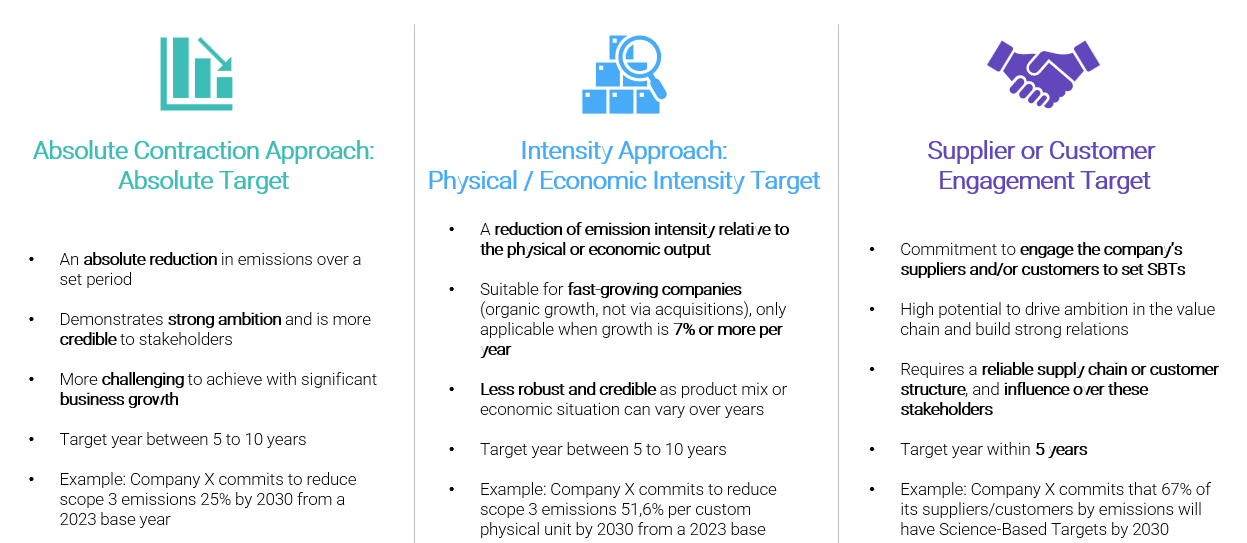
The 3 SBTi target setting methods include:
To move from possible to feasible, the next phase focused on reduction levers and measures. Möbius conducted desk research to develop a list of potential decarbonisation actions and complemented this with interviews across departments to quantify reduction potential and identify constraints.
The financial dimension was brought in through simulations of CAPEX and OPEX implications for Scope 1 and 2 measures. Particularly, for Scope 2, through a return on investment (ROI) model to evaluate the business case and payback period for the implementation of photovoltaic panels in Jensen’s sites.
The reduction actions were modelled directly in Carbon+Alt+Delete to show the impact of Scope 1, 2 and 3 reduction measures on the carbon footprint in the next 10 years and assess the feasibility of reaching the near-term SBTi reduction targets. For the Scope 3 reduction target we focused on the category Use of sold products which represents more than 95% of the JENSEN-GROUP’s Scope 3 emissions.
Submission of SBTi targets:
Finally, Möbius supported JENSEN-GROUP in completing the SBTi online submission platform. This included the greenhouse gas inventory results, near-term targets, and high-level reduction plan for Scope 1, 2, and 3.
Results
By the end of the project, JENSEN-GROUP has a structured system with clear ownership and audit-ready logic for its Corporate Carbon Footprint. The support from the Carbon+Alt+Delete tool enables the organisation to calculate its carbon footprint independently each year. JENSEN-GROUP also has a clear view of its SBTi near-term targets and the reduction levers needed to achieve them. The organisation is prepared to submit the near-term targets with SBTi and can easily follow-up progress toward the targets in Carbon+Alt+Delete.
Ready to turn your climate ambition into action? Let’s talk.
.jpg)


-3.png?width=410&height=220&name=Hamlet%20Carbon%20Footprint%20(1)-3.png)