-2.png?width=1200&height=630&name=Hamlet%20Carbon%20Footprint%20(1)-2.png)
Approach
Setting the CO2 baseline: a Corporate Carbon Footprint
The project began by establishing a comprehensive Corporate Carbon Footprint (CCF) for the 2023 base year. This covered Scope 1 (direct emissions), Scope 2 (purchased energy) and all relevant Scope 3 categories (value chain). This required defining the organisational boundaries for Hamlet’s head office, logistics centre and production sites. The analysis used real data and validated databases such as Agribalyse and the UK’s DEFRA, resulting in a robust baseline for the Corporate Carbon Footprint of a food and beverage company.
Setting Science Based Targets
Based on the final CCF, Möbius helped Hamlet define the specific reduction commitments needed for submission to the SBTi. The recommended targets, with financial year 2023 as the base year, were:
- Scope 1 and 2: a 43.8% reduction by 2030.
- Scope 3 industrial: an absolute reduction of 25% by 2030. This covers non-land-related emissions in category 3.1: purchased goods, services and packaging.
- Scope 3 FLAG: an absolute reduction of 30.3% by 2030. This covers land-related emissions in category 3.1: purchased goods, services and packaging, mainly from ingredients.
A feasibility plan for CO2 reduction
Möbius drew up a reduction plan to test the technical and financial feasibility of these targets. To do so, Möbius held interviews with internal data owners from various departments (e.g. Energy & Facilities, Transport, Procurement). This made it possible to identify and validate potential reduction measures.
Internally, this involved electrifying the vehicle fleet, switching to green electricity, phasing out natural gas and sustainable packaging. Externally, the focus was on sustainable sourcing and supplier engagement. Finally, the impact of these measures was combined and modelled across different scenarios for annual business growth, showing how much effort is really required.
Results
Clear SBTi targets and reduction potential
Hamlet gained a clear and detailed overview of the company’s CO2 footprint (with a confidence level of ±10%) and specific SBTi targets. The analysis confirmed that land-related emissions accounted for 66.3% of total emissions, underlining the need for the FLAG target.
High feasibility for Scope 1 and 2 emissions
The simulation demonstrated that the Scope 1 and 2 target (42% reduction) is highly achievable. Internal operational changes, such as switching to 100% renewable electricity contracts and implementing energy efficiency measures, are projected to result in reductions significantly exceeding the required goal. This confirmed that Hamlet’s internal efforts are robust enough to meet the 1.5°C pathway for its own operations.
The critical gap in Scope 3
The Scope 3 targets (a 25% reduction for industrial emissions and 30.3% for FLAG) proved considerably harder to meet. This is often the case for manufacturers that rely heavily on specific, emission-intensive ingredients such as chocolate. The feasibility study showed that current measures and passive reliance on suppliers’ existing targets are insufficient.
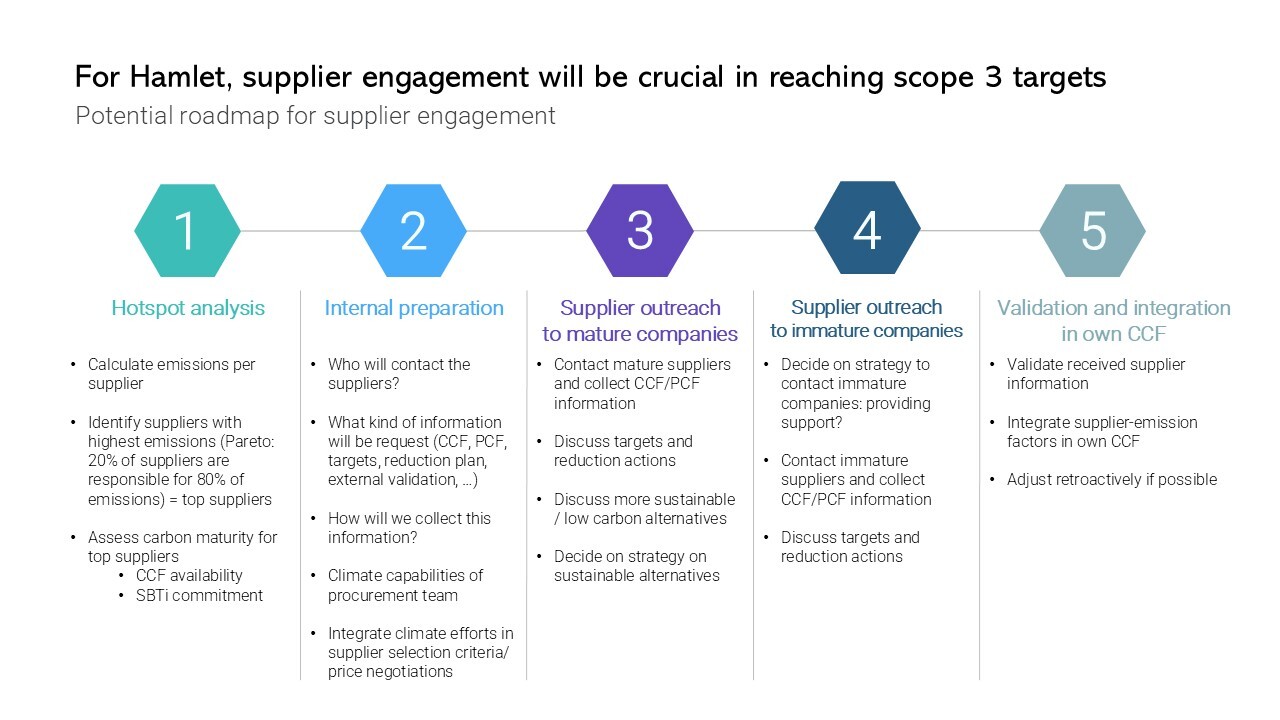
To close this gap, active, structured supplier engagement is the crucial next step. As a first step, the factory’s suppliers were contacted for more information on the carbon footprint of their products and possible low-carbon alternatives. Next, Hamlet will continue its efforts to further refine its CO2 footprint and meet its SBTi targets. This includes in-depth discussions with key suppliers to find sustainable products and to increase the share of recycled material in packaging.