How did Möbius approach it?
1. Mapping the then as-is staffing capacity and benchmarking
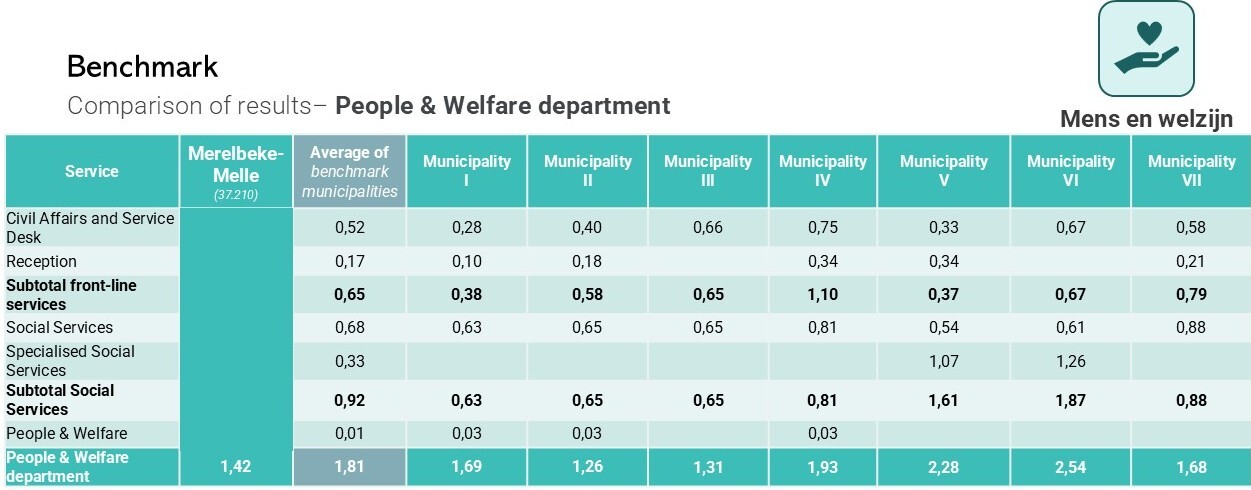
Möbius first mapped the then as-is staffing capacity by analysing FTE deployment, job levels and time allocation at macro-process level for each department. Möbius also developed a benchmark that allowed Merelbeke-Melle to be compared with seven other local authorities. Differences in FTE ratios, division of tasks, outsourcing and departmental structures were made visible. The benchmark served as a frame of reference throughout the project, but was always interpreted critically by giving sufficient context about the local authorities involved. Think, for instance, of the degree of outsourcing versus internal capacity.
2. Objectively determining future staffing needs
During bilateral rounds of talks with heads of department, the as-is analysis was compared with the results of the benchmark, and the political and administrative ambitions for each department’s core processes were mapped together (e.g. expanding services, policy ambitions, efficiency gains and digitalisation).
Based on these insights, Möbius worked with the management team to develop scenarios that determined where strengthening or reform was needed:
- Where can we scale down, and where do we need to strengthen or reform?
- Which competencies do we need, and where?
- Are there tasks or processes that still need to be transferred between departments?
Möbius formulated clear proposals for new and phased-out positions, grading and promotions, based on:
- The municipality’s current situation and capacity (FTE and level)
- Political and administrative ambitions
- Objective comparison through benchmarking with similar local authorities
- Möbius’s experience in other public organisations
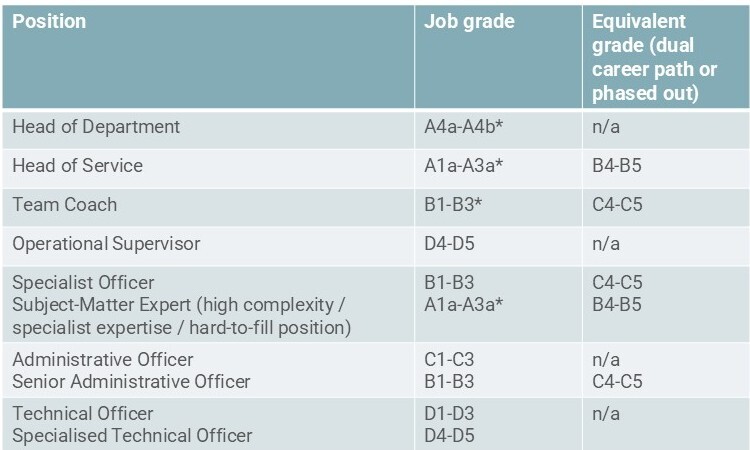
Moreover, the general principles for grading and promotions were applied, ensuring that positions were graded correctly and fairly in relation to the actual weight of the role.
For comparable policy positions, a job evaluation was carried out so that they could be graded objectively on the basis of content and responsibility.
3. Recommendations, implementation plan and final report
This project delivered a fully integrated and widely supported staffing plan that sets out future staffing needs, new positions, priorities and grading clearly and in phases. This phasing was set out in an implementation plan running until 2031. The final result takes into account the municipality’s budgetary context and policy ambitions.
The dynamic staffing tool makes it easy to monitor recruitment, promotions and staff turnover throughout the term of office.
4. In parallel: streamlining the processes of Merelbeke and Melle
Over the course of the project, Möbius optimised and integrated several processes by comparing the then as-is processes of Merelbeke and Melle, identifying bottlenecks and developing integrated process flows. The focus was mainly on improving the organisation of work through a better division of tasks, process improvement and digitalisation. The following processes were analysed:
-
Correspondence and customer contacts
-
Cemetery management
-
Environmental permits
-
Monitoring of building management and short-term rental of leisure facilities
-
ICT management
-
Communication with residents
Throughout the project, support was continually built by involving heads of department and heads of service, providing sufficient communication and briefing managers.
5. In parallel: integration of the technical services
Möbius supported the local authority of Merelbeke-Melle in integrating its technical services following the municipal merger. Central to this project was the development of a widely supported, future-oriented organisational model, with a focus on quality of service, efficiency and strong internal cooperation.
Through a structured approach with steering groups and participatory workshops, Möbius helped the administration make clear, well-founded choices. The work was based on a number of interrelated perspectives:
- Structure, roles and competencies
- Processes
- Equipment, vehicles and systems
- Location and depots
- Terms of employment
- Communication and cooperation
- Culture and employee experience
- Citizen-oriented service delivery
Möbius consistently translated these perspectives into concrete and workable recommendations, such as dividing staff into clearly defined teams with clear leadership, a well-defined division of roles between heads of service and team coaches, a practical layout of work zones, and clear choices regarding depots and working hours. These proposals were not merely indicative, but worked out operationally and ready for immediate implementation, enabling the administration to take decisions quickly and get the integration under way effectively.
There was also a strong focus on realising synergies and breaking down “us versus them” dynamics, with the aim of evolving towards a single integrated organisation. At the same time, Möbius paid particular attention to people-centred change, focusing on transparent communication, employee involvement and strengthening leadership.
The result is a clear and feasible future scenario that allows the administration to carry out the integration step by step and continue building a modern, efficient and attractive organisation.