

Burnout, as a mental health condition, is highly prevalent in today's society, where work takes centre stage. Although it is still often a taboo subject, everyone knows at least one person close to them who has experienced or is experiencing burnout. It is therefore important to strengthen existing initiatives, but also to propose a genuine national burnout prevention policy.
Minister of Social Affairs and Public Health Maggie De Block worked with various stakeholder institutions on an integrated and coordinated prevention policy for work-related mental health conditions, including burnout. Within this context, Möbius was asked to guide an ambitious project with significant societal impact: defining an integrated prevention plan for work-related mental health conditions. An integrated policy requires actions and projects at every level of prevention and intervention, combined with cross-cutting initiatives. Möbius applied a highly original approach for this purpose. Below, we outline the four key success factors. It is not our intention here to provide a medical approach to or characterisation of work-related conditions; this topic is, after all, extensively covered in specialised journals.
A systemic and multidisciplinary approach to a burnout prevention policy
We quickly established that the key success factor for the project lay precisely in the considerable complexity of the topic. Although work and the work environment are an important factor in the occurrence of burnout, it remains very difficult to pinpoint the exact origin of a burnout. It has been shown to be systemic in nature, which is why it is also essential to take various aspects into account in order to prevent burnout: the nature of workplace relationships, the organisational model and work-related culture, as well as the individual's personal situation and environment, personality, values, work-life balance, and so on. The field of action is therefore very broad. These different aspects are addressed in the long-term vision for burnout prevention, and all work-related mental health conditions, which were defined at the start of the project (Figure 1).
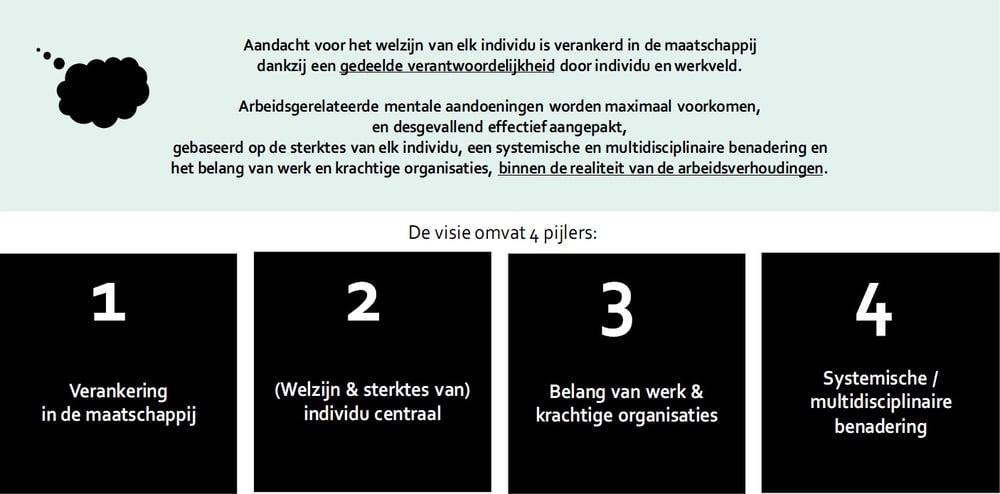
Figuur 1 : The « vision » of the prevention policy
Encouraging participation throughout the burnout prevention policy process
From the very start of the project in January 2018, we took into account the wide diversity of stakeholders and proposed a tailored plan of action. Various types of stakeholders were approached: employees of the institutions involved, general practitioners, psychiatrists, medical specialists, psychologists, burnout coaches, representatives of health insurance funds and insurance companies, the HR sector, managers, representatives of external and internal workplace prevention services, academics, social partners, and more.
Given the diversity of viewpoints involved, we proposed a series of participatory workshops, bringing together nearly 200 field and institutional stakeholders in total to develop a prevention plan. This prevention plan covers a range of objectives and actions intended to help realise the defined vision. The work was carried out in a genuine co-creation mode, and a network of stakeholders was formed. Participants themselves were very satisfied with this open approach, which also allowed them to immediately connect with complementary players in their field. Figure 2 summarises the main steps of the plan of action.
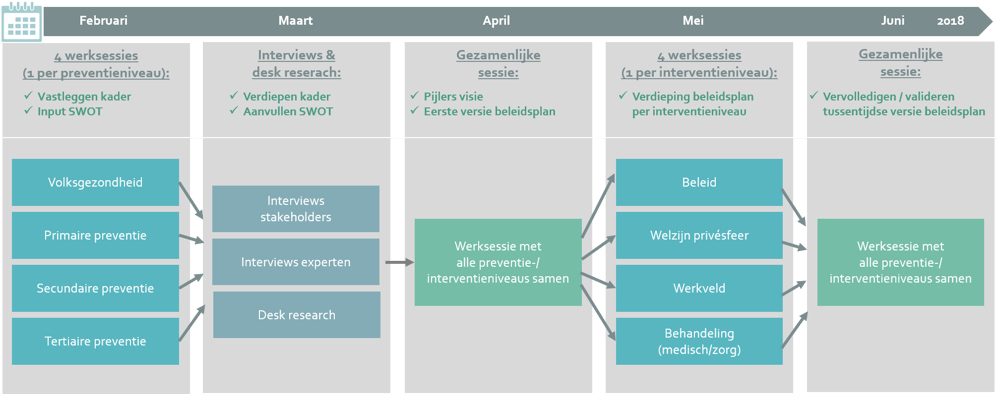
Figuur 2 : Plan of action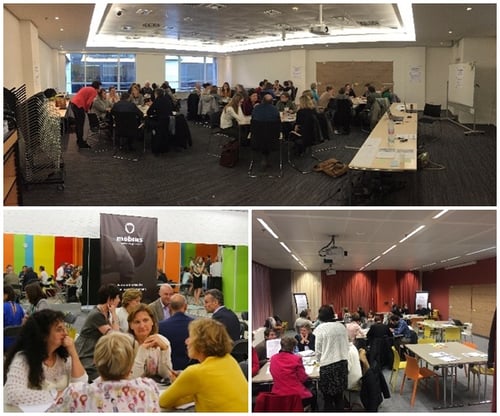
Figuur 3 : A participatory approach
A call for pilot projects and a dynamic tool to encourage the integration of different dimensions in the approach
Given the synergy being sought, it would have been a shame to propose a fixed outcome. For this reason, we proposed a dynamic tool, a framework that was shaped throughout the participatory sessions, in parallel with the development of the prevention plan.
The integrated prevention framework takes into account all the different dimensions required for an integrated prevention policy for work-related mental health conditions. To develop an integrated policy for the prevention and management of work-related mental health conditions, integration between the different levels of prevention and intervention is essential. The policy places the individual at its centre. This is also precisely why our integrated prevention framework covers all life stages of the individual; a work-related mental health condition can, after all, develop at any stage of one's professional life. The dynamic tool we used was an important instrument for encouraging the integration of actions in the call for pilot projects issued on 26 June 2018. Since these pilot projects were specifically aimed at putting the prevention plan into practice, an integrated and coordinated approach was of critical importance. These projects were intended to facilitate collaboration between the various stakeholders and to integrate the different levels of prevention and intervention, preferably also through a coordinated approach among the various players. We hope that this framework will be used again in the future when defining preventive actions for work-related mental health conditions (see Figure 4).
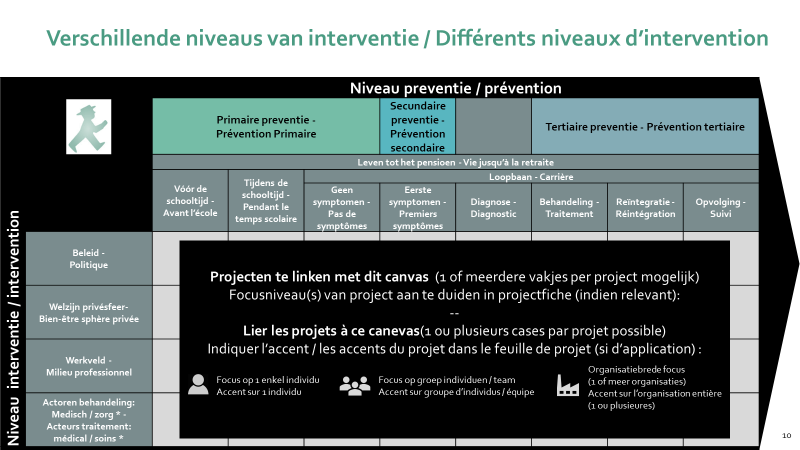
Figuur 4 : Integrated prevention framework
The establishment of a neutral selection committee to evaluate the pilot projects
The call for pilot projects was a great success. A total of 77 candidate project files were submitted: 52 cross-cutting projects (involving consortia of multiple organisations) and 25 individual projects (involving a single organisation).
To carry out the selection of projects and the evaluation of their results in 2019, Möbius established a neutral committee composed of employees from various institutions and academics. We also proposed a monitoring methodology advocating self-evaluation by the projects' own stakeholders, so that concrete results could be sustained even after the project's duration (until December 2019). Following lengthy discussions and the rigorous application of an objective methodology, 12 projects were selected, proposing actions across various sectors and professional categories:
The sectors covered by the selected pilot projects are as follows:
- Hospitals
- Commercial sector
- Non-profit sector
- Large enterprises
- SMEs
- Construction sector
The professional categories covered by the selected pilot projects are as follows:
- Employees
- Workers
- Self-employed individuals
- Contractual and statutory civil servants
For more information on the content of the selected pilot projects, please refer to the website of the FPS Social Security, where the information can be found here.