


Why disclose through CDP?
- Meet stakeholder expectations: CDP scores are closely watched by investors, ESG analysts, and business partners. A strong disclosure can improve access to capital and strengthen the reputation of your company.
- Compliance with regulations: CDP integrates with multiple global reporting standards, serving as a practical stepping stone toward compliance with CSRD, particularly on climate transition planning and double materiality.
- Benchmarking and risk management: CDP’s structured format supports peer benchmarking and the identification of environmental risks and hotspots across the value chain.
- Drive value chain impact: CDP enables large companies to engage their suppliers in environmental reporting, critical for reducing Scope 3 emissions.
How does CDP disclosure and assessment work?
CDP’s annual disclosure cycle includes:
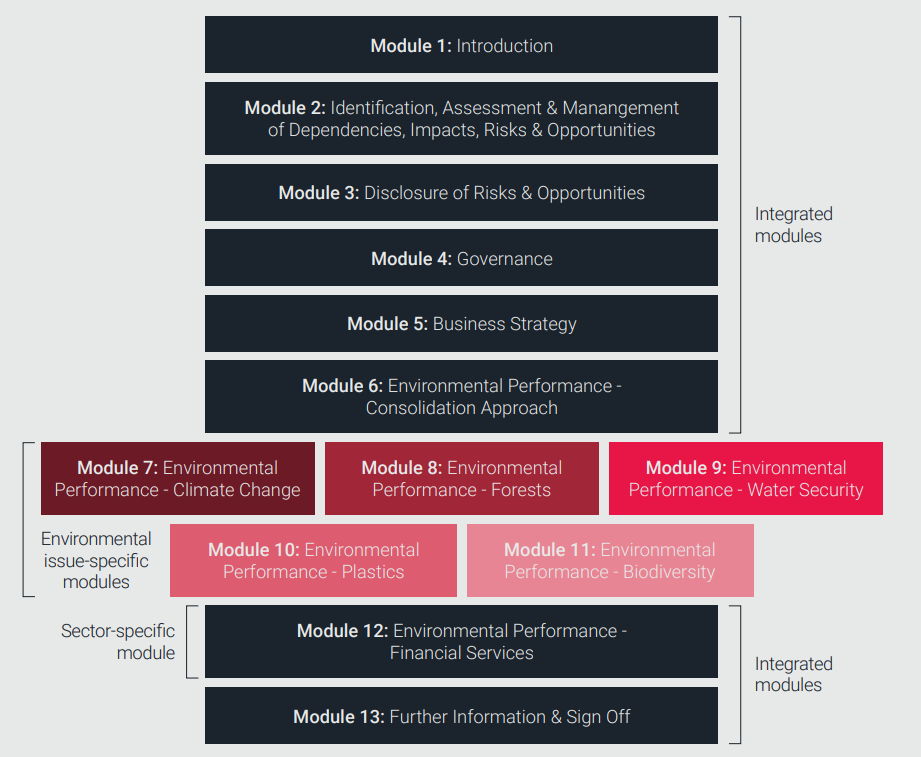
- Questionnaire selection: The questionnaire includes 13 modules but only module 1 to 6, and 13 are mandatory for all companies. Modules 7 to 12 are only material for companies from certain sectors. All modules are scored except modules 10 and 11.
- Data submission: The submission opens in June and closes in September. Companies report both qualitative and quantitative data via CDP’s platform.
- Assessment and scoring: CDP evaluates submissions across four levels: Disclosure (D), Awareness (C), Management (B), and Leadership (A).
- Feedback and benchmarking: After submission, companies receive feedback and a score. Companies also get insights in peer comparisons to support continuous improvement.
CDP’s scoring methodology helps companies and stakeholders understand the maturity of environmental management. Each topic (climate, water, forests) is scored separately based on the following framework:
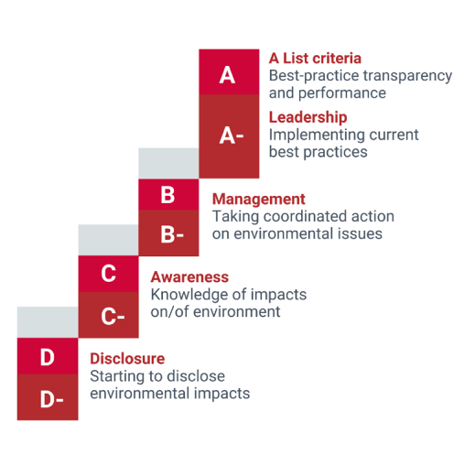
- A Leadership: Best practice in target-setting, data verification, and value chain engagement.
- B Management: Active integration of environmental issues into strategy, targets, and governance.
- C Awareness: Recognition of risks, impacts, and dependencies.
- D Disclosure: Basic reporting of environmental data; initial step toward transparency.
High scores are a clear signal of leadership in ESG and climate maturity. Scoring is based on CDP’s detailed guidance and can change over the years to reflect evolving best practices.
Our approach
Möbius supported Proximus in their CDP disclosure cycle, with work structured around governance, data, and submission quality.
We started by assessing the previous submission against CDP’s guidance and scoring logic, pinpointing where points were being left on the table and where the submission needed stronger “leadership signals.” From there, we helped Proximus strengthen the foundations of the response.
First, we streamlined the underlying data process. We supported Proximus in improving coordination across internal stakeholders, consolidating key datasets, and ensuring consistency between quantitative disclosures and qualitative explanations. That improved both the reliability of the answers and the efficiency of the process.
Then, we elevated the submission quality. Together with Proximus, we refined narratives across the modules to align with CDP terminology and scoring expectations. We strengthened the logic linking strategy, risks, targets, actions, and progress, and ensured claims were backed by clear proof points (policies, controls, verification approaches, and plans). The result was a submission that read as one coherent, leadership-level story, rather than a collection of disconnected responses.
Results
This structured and strategic approach helped Proximus achieve a CDP A score for two consecutive years, positioning the company among global leaders in environmental transparency and action.
Beyond the score, Proximus came out of the engagement with a stronger disclosure engine: clearer governance articulation, smoother internal data collaboration, and a more credible, audit-ready narrative that can keep pace with evolving expectations from regulators and stakeholders.
Want to start your CDP journey or strengthen your score? Get in touch with our sustainability experts.
.jpg)