
Operational excellence has become a common term in business. Many organizations start an improvement program full of enthusiasm, but see the results melt away over time. What goes wrong? Leon van der Loo, expert operational excellence at Möbius and one of the founders of the Enterprise Excellence Model, puts his finger on the sore spot.
Leon has been leading the operational excellence service at Möbius in the Netherlands for almost ten years now. Before that, he worked in industry for more than 25 years. During that time he supervised many OpEx programs, mainly in industry, business services and retail, but with some forays into the public sector. By now he is all too familiar with the patterns surrounding the success and failure of improvement programs.
"If I had to name the three most important lessons from my career," says Leon, "they are these: operational excellence should never be separated from the broader strategy and operating model. Change does not fail because of bad plans, but because of lack of support. And the transition is only successful when change has turned into routine."
Tools follow outcomes, not the other way around
That first point sounds obvious, but in practice it regularly falls short. The toolbox of operational excellence contains dozens of tools - think day starters on the shop floor, A3 methodologies for structured problem solving or performance boards that make progress visible.
All are useful methods, but organizations often roll them out as ends in themselves without first defining the desired outcome. "These tools are tools to guide routines and behaviors," Leon explains. "You must first think about what your desired outcome is: what result do you want to achieve, what culture do you want to see? Only then do you choose the tools that contribute to that."
That approach is reflected in one of his most outspoken views: "I personally prefer not to call it lean or OpEx implementation, but change management where we cleverly use lean tools to drive behavior. By approaching it that way, you build something that is sustainably anchored and self-correcting."
In that view, support is not a prerequisite but the core. Leadership support is necessary, but ultimately it is the employees - the experts on the shop floor - who make the difference. "Culture is the sum of all behaviors," sums up Leon. "And if you want to change behaviors, you have to design the systems that trigger and reinforce those behaviors. Without those systems, even the best intentions fall apart."
From change to routine
With that, Leon touches on his third lesson: change must be turned into routine. "Many people choose a diet, lose weight, regain it a few months later, and then start looking for a new diet - the classic yo-yo effect," he explains.
What goes wrong then? "They take an approach that works, but doesn't fit into their daily habits. Those who want sustainable change must change their eating and living habits, and that's really different from dieting."
He sees the same pattern in organizations. A routine that works perfectly with one group can completely bleed to death with another. "Then the tendency is to say: why don't people follow what we agreed on together? But that's the wrong question. If people have shown that they want to change, apparently the routine is not strong enough. Then you have to improve the routine, not the people."
Neurology supports this: more than 40 percent of our behavior is automatic, driven by the cerebellum that operates at a rate of 11 million bits per second. "Our brain naturally prefers routines that require little energy. Those who want to embed change would do well to capitalize on that mechanism rather than go against it. Consider unconsciously competent behavior."
The Enterprise Excellence Model
To address all these elements in context, Möbius developed the Enterprise Excellence Model. That provides a practical framework of five interconnected pillars.
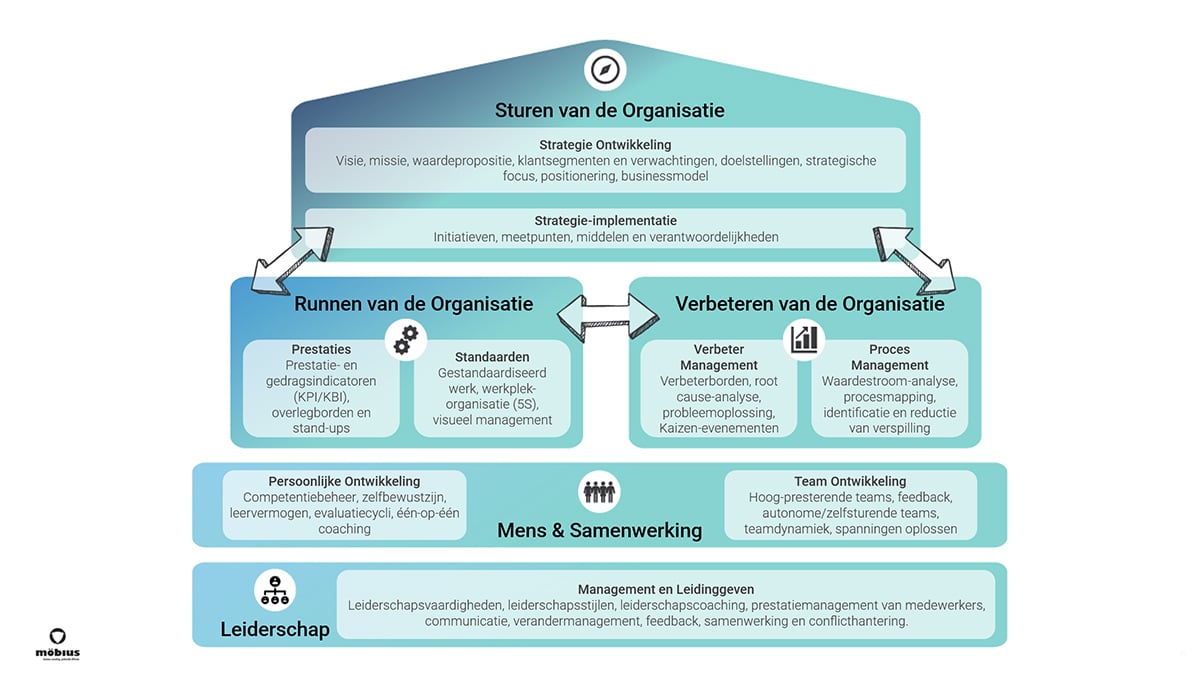
The first two are about steering and running the business: strategy development and rollout so everyone understands the direction, combined with structured performance dialogues and standards that create stability. "You can't start improving until the foundation is stable," Leon emphasizes.
So in the model, you must first focus on "running the business" before you can move on to the third pillar, improvement: raising the bar through structured problem solving and end-to-end process improvement. And people find that complicated or less fun. "After all, improving is much more fun ('sexier') than making everything stable."
In his view, the fourth and fifth pillars - people and leadership - are not supportive but guiding. Employees are the company's experts and deserve sufficient space for personal and team development. Leaders at all levels are the driving force behind change: they must not only give direction, but demonstrate the desired behavior themselves.
In practice
How this works out in practice illustrates a process Möbius went through at Brocacef, a wholesaler of pharmaceutical products. The organization was struggling with operational challenges and a culture that needed improvement in terms of ownership and cooperation.
Möbius set up a consultation cycle that connected all layers, supported by visual management and Gemba-walks that made leaders structurally visible on the shop floor. The approach led to better collaboration, faster problem solving and demonstrably more ownership and motivation among employees. Brocacef received both the internal Lean Award from parent company Phoenix and the external prestigious Kaizen Award from the Kaizen Institute in 2025.
"Operational excellence is often launched with great energy and enthusiasm. But maintaining that momentum is where many organizations stumble," Leon concludes. "It's ultimately about moving from a one-time change to an ongoing culture and mindset - and that always starts with translating good intentions into sustainable routines."