
Building tomorrow’s care together in a changing healthcare landscape
We are at a turning point in Belgian healthcare. Well-known challenges – such as the double ageing of the population, a structurally tight labour market (the “war for talent”), and increasingly complex care needs – are placing continuous pressure on our healthcare system. At the same time, we are confronted with significant societal challenges. This reality creates a genuine sense of urgency.
Health is far more than the absence of disease. It is the result of an interplay of multiple factors – an insight that strongly resonates with the WHO’s One Health principle. In addition to medical factors, health is largely determined by ecological influences and environmental conditions, as well as by economic and psychosocial determinants (such as housing, employment and education).
Because all these factors are so closely interconnected, our traditional silo structures fall short. A fragmented approach may address the symptoms, but rarely tackles the underlying causes. No single sector – neither hospitals, primary care, nor wellbeing organisations – has the tools on its own to provide sustainable answers to this complex reality.
From systems thinking to actionable change: drivers of transformation
Intersectoral collaboration is no longer a voluntary ambition, but a necessary condition for organising care and wellbeing in a future-proof and trans-mural way. Together, we are shaping the healthcare of tomorrow by deliberately bridging wellbeing and healthcare, with stakeholders across institutional boundaries engaging in societal partnerships and sharing responsibility to support vulnerable individuals through a holistic approach.
In this way, intersectoral collaboration can become the engine of a healthier and more inclusive society. The need for this is driven by several important shifts within the healthcare landscape.
Sextuple Aim as a compass for integrated care
The starting point is no longer the services offered by a particular institution or sector, but the unique needs and quality of life of an individual. This holistic, needs-driven approach requires an integrated ecosystem in which different actors – including the citizen, the hospital, the (general) practitioner, the domiciliary nurse, the social worker and the local community – collaborate seamlessly.
In this context, investing in citizens’ health literacy (patient empowerment) and shared decision-making is not a nice-tot-have, but an absolute must for integration. From this Sextuple Aim perspective, we can successfully build this integrated ecosystem within healthcare.
Reforming the healthcare landscape and trans-mural care
The hospital is no longer the epicentre of healthcare – as is also reflected in the expert report on the reform of the Belgian hospital landscape. Patients move continuously within and between sectors. Trans-mural care therefore requires seamless collaboration between hospitals, primary care and wellbeing actors, based on an equal partnership between medical professionals, wellbeing workers and the local community. However, it is also true that hospitals remain a key driving force in the reform of the healthcare landscape.
The shift from 'cure' to 'care'
We are evolving from a model focused on the medical treatment of illness (“cure”) towards broader, holistic support with a proactive emphasis on preventive care (“care”). This shift requires the healthcare and wellbeing sectors to become structurally intertwined.
Inclusion within care and welfare
Vulnerable individuals should no longer unnecessarily grow up in parallel systems. Society itself must adapt. Mainstream services such as childcare, schools and leisure activities must become more accessible. This requires intensive collaboration and knowledge sharing between specialised organisations within care and wellbeing.
Economic and societal necessity
Health and societal participation are closely linked. A well-supported and healthy citizen is more productive. Breaking down the walls between healthcare, wellbeing and society is therefore not only a social necessity, but also an economic one.
Although existing frameworks and systems shape our behaviour, we must not become paralysed by their limitations or rigidity. Systems may influence behaviour, but ultimately it is people who carry those systems and drive change. And that change is necessary if we want to preserve our solidarity-based healthcare system. If we continue to develop solutions within separate sectors, we will maintain silo thinking and the barriers separating sectors and institutions.
We must use the current sense of urgency as a stepping stone for intersectoral collaboration. The future of care and wellbeing is not an abstract policy concept, but it is being shaped today on the job, where professionals show the courage to build connections across boundaries. Let us start from an inspiring “Yes, we can” mindset and explore how we can truly set this engine in motion.
The engine in motion: tools for intersectoral collaboration
Although the need for intersectoral collaboration is widely recognised, it does not happen automatically. Collaboration requires targeted levers to translate intentions into practice.
Relational foundations between hospitals, primary care and wellbeing actors
Collaboration grows where professionals recognise one another and build trust. This requires the courage to move beyond one’s own territory and to gain insight into each other’s expertise and working context. In this way, space is created for shared responsibility and a clear division of tasks.
This partnership should not be limited to medical actors alone. Wellbeing organisations must also be fully involved to realise truly integrated care. Continuing to meet one another, making concrete agreements and regularly adjusting them: that is all it needs to be for a first step.
Clear governance, shared language and common goals within the healthcare system
There is a need for clear objectives, roles and responsibilities to ensure that collaboration does not remain a non-committal exercise. Organisations must consciously choose appropriate models of collaboration and develop a shared language in order to work together effectively.
What does this look like in practice? From informal networks to more advanced forms of collaboration, a variety of models can be explored. To increase the chances of success, it is essential to understand each other’s jargon and align visions and frames of reference. With a shared vocabulary and a degree of creativity in organisational design, gradual steps can be taken towards intersectoral (including legal) forms of collaboration.
Digital interoperability as the binding force for trans-mural care
Although a considerable amount of data is already available today, systems still communicate too little with one another. A first step is therefore to map existing data sources and make well-considered choices in the development and selection of future digital health records, always with collaboration as the guiding principle.
Smooth and secure information exchange forms an essential building block for trans-mural care. Digital interoperability and smart use of data make it possible to guide patients seamlessly through the healthcare landscape.
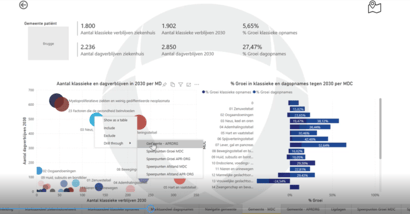
By combining health and wellbeing data, organisations can look beyond their own walls and gain valuable population insights that reveal the broader picture (for example, the link between poor housing and health problems). These insights clearly demonstrate that collaboration is essential to address underlying causes in a preventive and structural way.
Local care regions as the foundation of a strong healthcare landscape
Care and wellbeing must be locally embedded in care regions with clear mandates and shared responsibilities. Local medical centres can act as a bridge between primary care and hospitals, with a focus on planned (day) care, chronic follow-up, health education and preventive care.
Anchoring preventive care and strengthening primary care
A strong prevention policy and well-organised primary care are cornerstones of a sustainable healthcare system.
Consider, for example, the joint management of chronic conditions (such as diabetes, hypertension or COPD), in which the GP, pharmacist, community nursing services and wellbeing workers collaborate. Lifestyle interventions and health education can help stabilise the condition or prevent it from progressing. A broader policy framework is essential, but it can already help to initiate joint initiatives.
Facilitating patient empowerment in healthcare and wellbeing
To truly place citizens at the centre, systems and professionals must support them with the right skills and tools. Initiatives within primary care zones can help train citizens to become co-directors of their own care and wellbeing pathways.
Start small and build the future of care
Start today with small, concrete steps. Small-scale, practice-oriented initiatives – such as discussing cases, work visits or job shadowing within partner organisations – are the fuel for learning and improvement.
Flexible regulatory frameworks and pilot environments create space to test forms of intersectoral collaboration, for example through programmes such as ToekomstZorg. Use your creativity, think in a solution-oriented way and consolidate what works to start building (temporary) bridges today towards structural measures. In this way, intersectoral collaboration will not remain an abstract policy concept, but a reality that is tangible today for care users, healthcare professionals and our society.