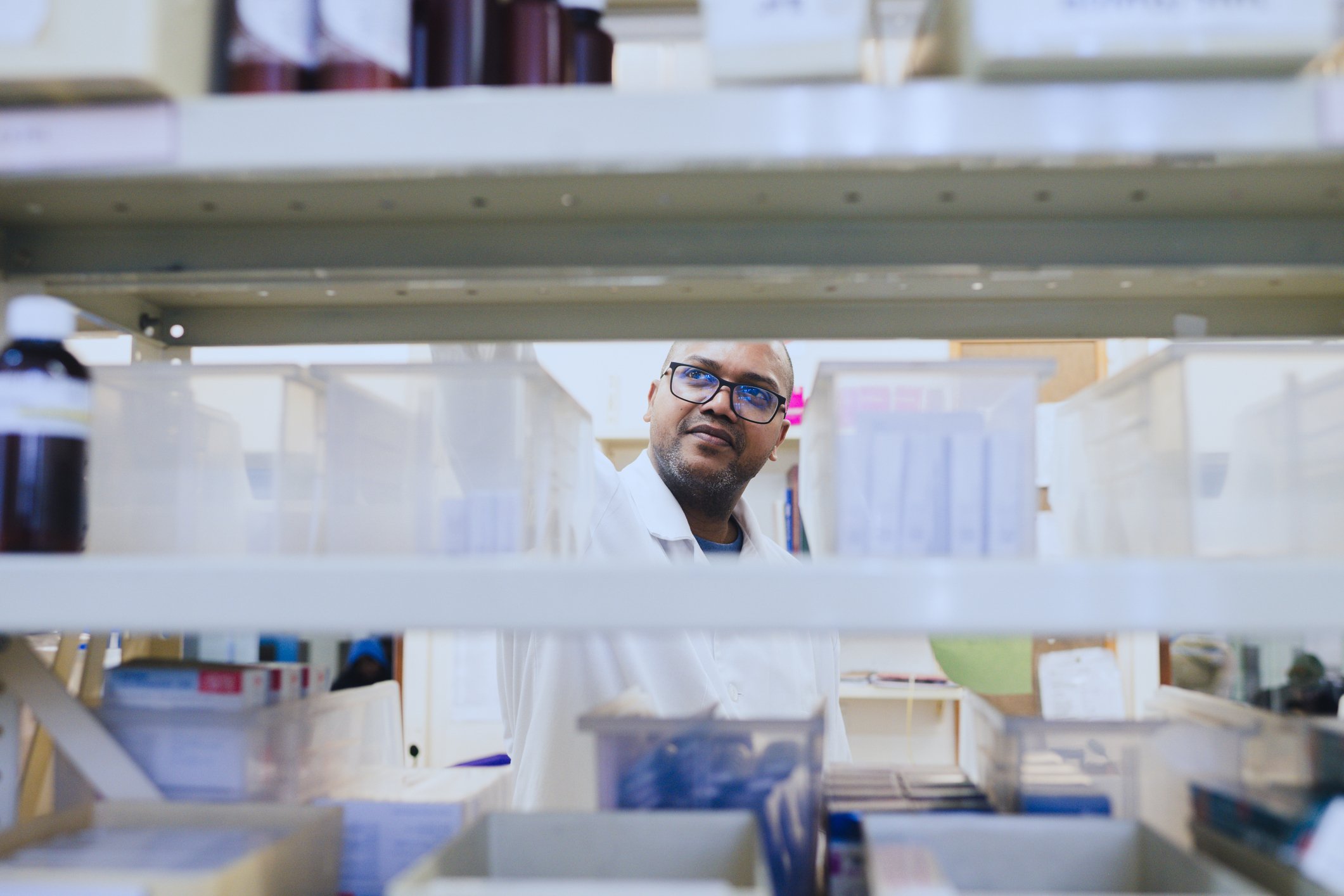
The hospital pharmacy is a crucial link in delivering safe, efficient and patient-centred care. Within this environment, various highly trained professionals work together, providing substantial added value to the entire care process and the broader healthcare logistics chain. Yet this potential often remains underused. In daily practice, valuable time is lost to logistical and administrative tasks — time that could be better spent on activities with higher added value.
This represents a missed opportunity, especially at a time when the healthcare sector faces staff shortages and financial pressures, forcing hospitals to use resources as efficiently as possible. Every organisation must therefore dare to ask: “Is our hospital pharmacy doing the right things in the most cost-efficient way?”
With our framework for pharmacy excellence, we support hospitals in analysing, objectifying and strengthening the effectiveness and efficiency of their hospital pharmacy. We tailor our approach to your organisation and invest in improvements that truly make an impact for patients, staff and care processes.
If you are interested, feel free to contact us to explore how your hospital can take the next step.
Our vision on pharmacy excellence
At Möbius, we believe that pharmacy excellence grows from a balanced combination of strategy, process and people, with the hospital pharmacy acting as a fully fledged partner in both quality of care and healthcare logistics.
Strategy: the pharmacy as a strategic partner
The pharmacy is deployed as a full strategic partner in healthcare policy, directly influencing care quality, patient safety, financial health and sustainability.
💡 Example:
Deploying pharmacists to design and closely monitor an antibiotic policy — in close collaboration with clinical biologists, physicians and nurses — reduces antibiotic consumption and lowers the number of resistant infections. A strong IV-to-oral switch policy also contributes to better patient outcomes. Both typically have a positive financial impact on the hospital pharmacy.
💡 Example:
A rational procurement policy — both for medicines and medical materials — based on data analysis (usage patterns) and scientific evidence can significantly increase the cost efficiency of the hospital pharmacy.
Process: clear, reliable and efficient healthcare logistics
Processes within the hospital pharmacy must be streamlined, well-understood and efficient, supported by technology that empowers staff.
💡 Example:
Through automation of logistical processes or improved IT support for administrative tasks, valuable time can be freed up for hospital pharmacists and pharmacy assistants to focus on higher-value activities.
💡 Example:
Automation in medicines distribution and preparation enables the digitisation of double checks — which are often still performed manually — through barcode validation.
People: using expertise where it creates the most impact
Pharmacy staff should have the space to apply their expertise where it matters most, close to the healthcare professional and the patient.
💡 Example:
Pharmacists contribute to clinical pharmacy, through back-office monitoring and adjustment of prescribing behaviour and by supporting physicians and nurses on the ward in optimising medication management.
💡 Example:
Pharmaceutical-technical assistants can support wards by preparing medication, verifying home medication or managing the switch from formulary to home medication at discharge.
Pharmacy excellence is not an end point but a continuous path of growth and improvement that leads step by step to a high-performing, modern hospital pharmacy.
Our approach: from insight to impact
Together, we analyse where the pharmacy stands today and where it can grow.
We ask questions such as:
- Are we delivering the right medication to the right patient at the right time?
- Are our internal customers satisfied?
- Does the pharmacy maximise its support for care processes and healthcare logistics?
- Is stock management under control, with minimal inventory discrepancies?
- Is invoicing timely, correct and complete?
- Can staff fully apply their expertise?
This analysis reveals where improvement potential lies. Four common levers often emerge in improvement programmes:
A clear horizon
Together with all stakeholders, we map out the strategic vision for the hospital pharmacy, ensuring that every internal customer knows what to expect and that financial resources are aligned with this vision.
Process simplification
We eliminate unnecessary steps, clarify roles and responsibilities inside and outside the pharmacy, standardise processes and automate where possible — freeing up time for clinical and strategic tasks.
Role differentiation
We reassess staff deployment to ensure every team member is working where their expertise provides the greatest value — from assistants supporting medication distribution on wards or mapping home medication, to pharmacists focusing on clinical pharmacy and innovation.
Scaling up
We explore opportunities for collaboration with other healthcare actors — at both organisational and departmental level — to better utilise resources, share expertise and strengthen continuity, without losing the proximity and accessibility that make care humane.
Together with all stakeholders, we map out the strategic vision for the hospital pharmacy so that each client knows what can and should be expected from the pharmacy, and so that financial resources are deployed to support this strategic vision.
Our role in your transformation
To support you in moving from concept to implementation, we adopt the role that best fits the needs of your hospital and pharmacy.
Coach and trainer
We coach the pharmacy team and hospital management in defining the strategic direction and translating it into everyday practice.
💡 Example: Supporting a strategic exercise to clarify the long-term role of the hospital pharmacy.
💡 Example: Coaching the head pharmacist in transforming a pharmacy focused on process monitoring towards a more entrepreneurial role supporting quality of care.
Business case author
We underpin strategic decisions with facts, figures and impact analysis.
💡 Example: Calculating the financial impact of investment options or scaling scenarios and providing the figures required for strategic decision-making.
Facilitator or programme manager
We provide structure, progress monitoring and stakeholder engagement in complex change processes.
💡 Example: Guiding the establishment of a regional collaboration between hospital pharmacies.
Improvement programme guide
We translate insights into concrete improvement actions.
💡 Example: Conducting a workflow analysis to redesign the pharmacy space or optimise logistical routes, reducing walking time for assistants.
The result: An excellent hospital pharmacy
An excellent hospital pharmacy:
- is strategically anchored in the hospital vision,
- delivers quality, efficiency and continuity,
- creates value for patients, staff, healthcare logistics and the hospital as a whole.
Pharmacy excellence goes beyond optimisation: it represents a transformation in which the hospital pharmacy evolves into a strategic partner in the care process.
Ready for the next step?
Contact us to discover how we can build a stronger, more efficient and more impactful hospital pharmacy together.