The move to a new workplace always comes with questions and often with assumptions. Will it be noisy? Will there still be enough space to focus? Will collaboration become more difficult? These concerns are understandable, especially as organisations adopt NWOW principles and rethink modern workplace and office design.
But many of the fears surrounding activity-based working come from misconceptions rather than reality. A well-designed modern workplace is not about removing comfort or structure. It is about creating environments that better support the way people actually work today: focused, collaborative, hybrid, virtual, and in person.
Let’s take a closer look at some of the most common myths surrounding NWOW and what research and experience actually tell us.
Common myths about the modern workplace
It is 10:00 in the morning.
Someone is on a loud call next to you. Another colleague is hosting a meeting at their desk. A third is searching for a quiet corner. Meanwhile, you’re trying to concentrate.
If that sounds chaotic, don’t worry — this is not what we have planned for the new building. This is what happens when activities and spaces do not match. Good office design prevents exactly this situation. Let’s separate perception from reality.
Myth 1: “It will be too noisy. I won’t be able to concentrate.”
This is the number one concern in almost every organisation implementing NWOW or activity-based working.
Now here’s the data:
Leesman research shows that focused individual work is the most important workplace activity across industries. Most employees rate focus work as critical to performance.
That is exactly why modern workplace and office design are built around different work activities:
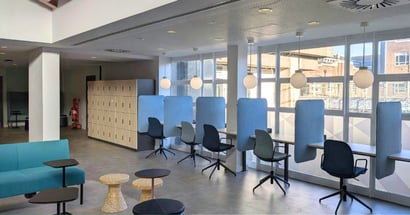
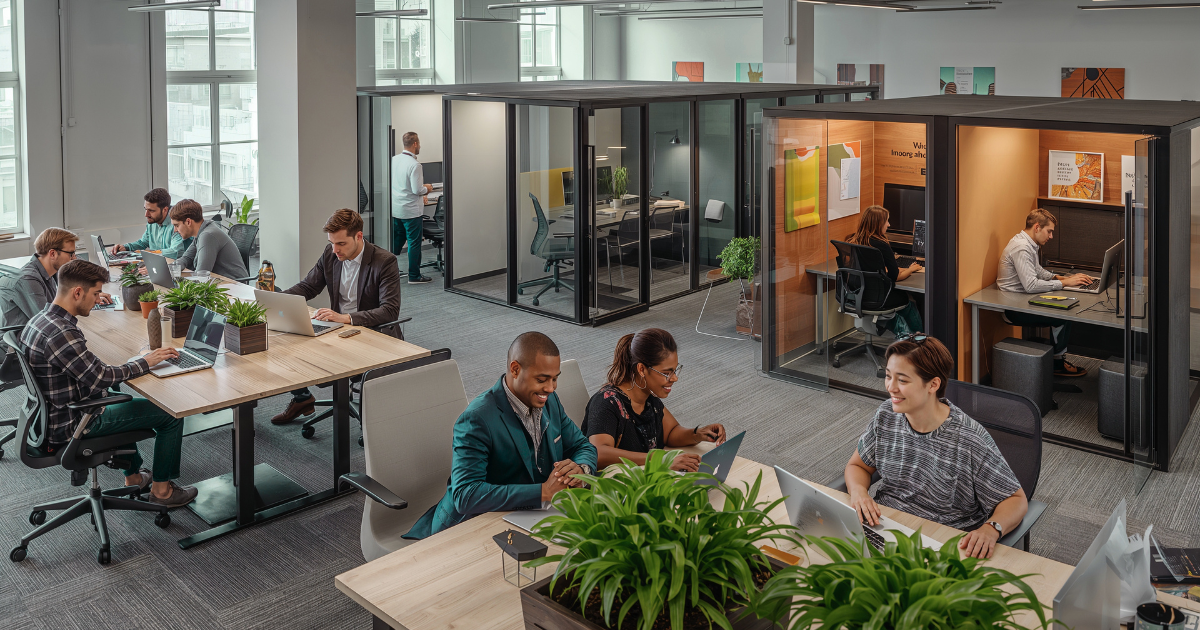
- Calls → phone booths or meeting rooms
- Meetings → dedicated collaboration spaces
- Need to concentrate → silent zones or focus areas
The issue is not people talking. The issue is people talking in the wrong place. When spaces are clearly defined and correctly used, noise does not increase — it decreases.
A successful NWOW environment creates balance between collaboration and concentration by offering employees the right setting for the task at hand.
Myth 2: “It’s going to be a daily chair dance.”
No one is asking you to start your morning with a competitive round of musical chairs.
Desk sharing mainly optimises space when people are not in the office — working remotely, travelling, or visiting customers. Hybrid workplace data shows desks are unoccupied 30–50% of the time during the week. That aligns with what we see internally.
In a modern workplace, office design is based on actual workplace behaviour rather than outdated assumptions about fixed desk usage.
Will you have a favourite spot? Very likely.
Will someone use it while you’re away? Possibly.
Will it harm productivity? Unlikely.
NWOW is designed to support flexibility while still giving employees access to the spaces they need throughout the day.
Myth 3: “I’m in back-to-back calls all day. This won’t work for me.”
If your calendar is a solid blue wall, you’re not alone.
Research on hybrid work patterns shows that the number of scheduled meetings has increased significantly in recent years. When spontaneous exchanges decreased, we compensated by formalising everything.
Activity-based working and modern office design are not about reducing communication — they are about improving the quality of interaction.
Could some virtual meetings become in-person conversations with colleagues onsite?
Could updates be shared beforehand, so meeting time is used for decisions and collaboration?
Could calls take place in dedicated booths rather than open work areas?
The objective is not fewer conversations. It is better conversations — in the right place, for the right purpose.
A successful NWOW environment ensures there are spaces for collaboration, calls, workshops, and focused work without one activity disrupting another.
Myth 4: “This is just about saving space.”
Let’s be honest: optimisation is in our Western Europe DNA.
But NWOW and activity-based working are not simply real estate exercises. They are performance strategies supported by modern workplace thinking and intelligent office design.
Work has changed: desks sit empty 30–50% of the time. At the same time, people struggle to find the right space for concentration or collaboration. That is not efficient — that is misalignment.
Activity-based working corrects that. It aligns workplace design with actual work patterns and supports performance, wellbeing, and collaboration — not just occupancy targets.
So yes, we optimise. But we optimise to work better.
Conclusion
Activity-based working is not about removing desks or forcing change for the sake of change. It is about creating an environment that better supports the way we already work today: sometimes focused, sometimes collaborative, sometimes virtual, sometimes in person.
The goal of the new building is simple — to give people the right setting for the task at hand. Through thoughtful NWOW implementation, modern workplace strategies, and intelligent office design, organisations can create workplaces that are not only more efficient, but also more comfortable, productive, and effective for everyone.

.jpg)