
Hospitals are operating in an increasingly complex and demanding environment. On the one hand, there is growing pressure to cut costs while improving the quality of care, and on the other, a shortage of human resources, increased specialisation in equipment requirements (sterile medical devices, implantable medical devices, re-sterilisable devices) and an increase in stock-outs (sterile medical devices, implantable medical devices, drugs, non-sterilised items). In addition, the proportion of logistical work previously carried out by practitioners is decreasing, allowing them to concentrate on their care activities. This makes managing stocks and equipment even more difficult . Against this backdrop, the need to optimise the supply chain has become crucial to guaranteeing the sustainability and efficiency of hospital services.
The strengthening of partnerships between hospitals has paved the way for the implementation of logistics platforms. Sharing resources allows hospitals to make economies of scale at different stages of the process, to professionalise their processes and to rebalance their relationships with suppliers... However, the introduction of these solutions remains relatively confidential in Belgium. So what are the key factors you need to work on to develop an optimal logistics platform?
The characteristics of the logistics platform of the future
The hospital logistics platform of the future must be designed to respond proactively to the changing needs of healthcare institutions. Here are some key features:
1. Real-time inventory management
The implementation of a Warehouse Management System (WMS) should provide a clear picture of stock levels, their location and the flow of goods. This is a key principle in optimising volumes stored, storage areas used and resources required.
As well as optimising storage space at a given point in time, the use of data linked to tracking movements of stock enables it to be optimised over time by analysing consumption (who, when, how much) in order to adapt the references to be kept (quantity, format, location), or even by anticipating needs on the basis of predictive models.
As a result, the WMS saves floor space at the design stage (no empty space waiting to be restocked) but also throughout the life of the platform (no dormant items).
2. Optimising logistics flows
The optimisation of logistics flows aims to improve how efficiently goods move within the platform, right up to the care facilities. It is based on Lean principles, identifying the added value of each stage and each resource in order to reduce the various forms of waste (the seven mudas) and make processes more fluid. This reduces the time it takes to make items available after an order has been placed and cuts operating costs.

3. Advanced automation
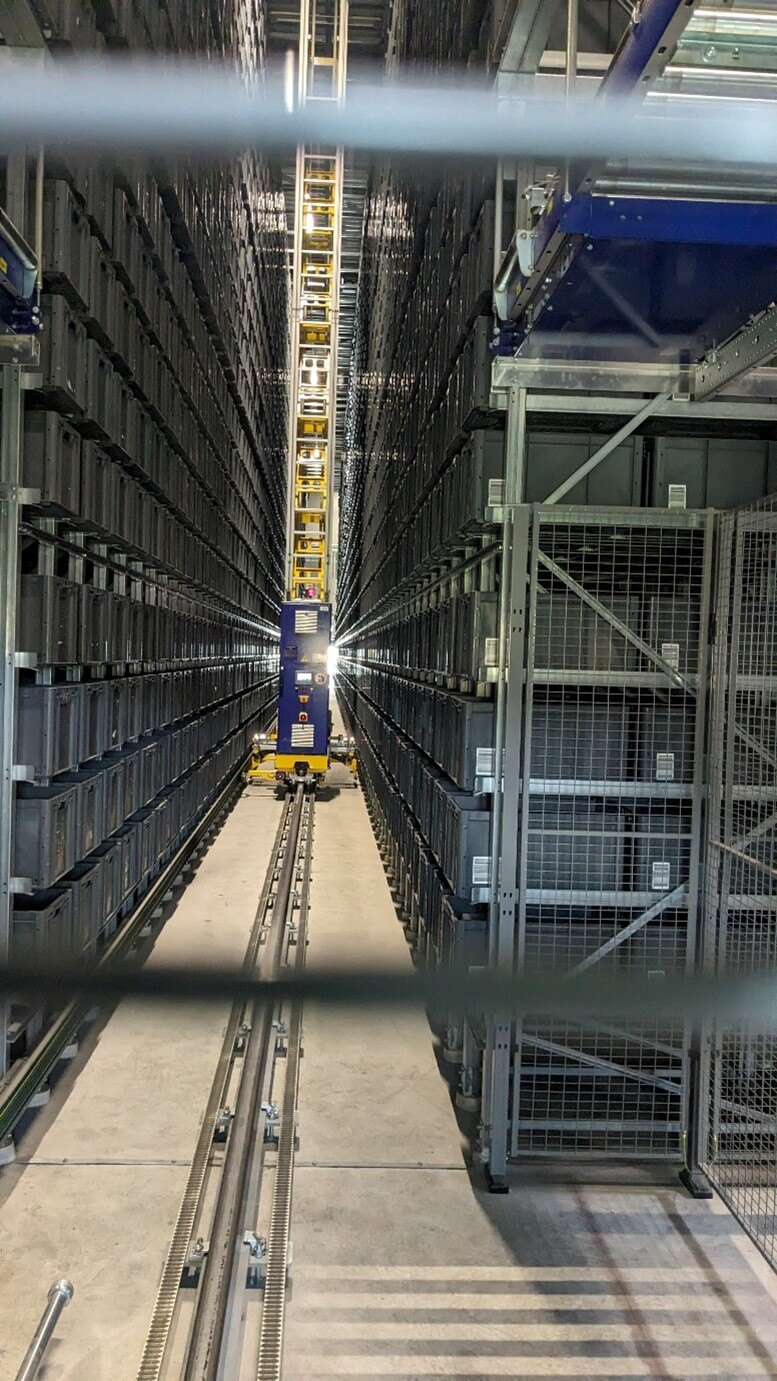
Automation is a complementary solution that enhances process and inventory management. It enables us to work on two crucial aspects of the process, namely reducing heavy handling and error rates. Automation is regularly suggested to support preparing orders, as a way of optimising storage space, or even within institutions as a way of getting materials from one point to another.
Automation means that tasks can be carried out more quickly while reducing the workload. These points are often assessed in feasibility studies by analysing the times for each automated task, comparing them with the manual situation and allocating costs. This gives the potential financial gain from automation.
Reducing the error rate should also be a consideration, as it has a significant impact on end-user satisfaction, the ability to predict how the activity will develop, workload smoothing and, ultimately, the budget. For example, for a platform preparing +/- 500,000 order lines, error management can represent one FTE in the logistics department.
By reducing handling and the risk of error inherent in human work, automation is profoundly changing the nature of the tasks to be carried out and the skills required to support logistics operations.
Automation is also an opportunity to change the paradigm of logistics flows. Whereas in a 'manual' system, the most time-consuming task is preparing orders for the departments, in an automated model, it's putting items into stock. This makes it possible to plan increases in the frequency of deliveries to units and therefore to reduce the amount of storage space in units.
4. Customisation and adaptability
Tailor-made solutions aim to deliver different services according to needs and how they evolve over time. Before these solutions can be implemented, a framework must be put in place for collaboration between the various parties so that they can all organise themselves as effectively as possible. Nevertheless, the decision to follow this route must be clearly communicated in order to build a process that will ultimately be more flexible and adaptable to changing needs.
Through the inventory management system, it is also possible to assess fluctuations in requirements, anticipate them and adapt human resources to variations in activity .
It should be noted here that personalisation cannot be .... but must also extend upstream of the platform . Developing partnerships with suppliers, including performance clauses or setting shared objectives between the supplier and the shop, is one of the keys to reducing stock shortages. As such, it is a good idea to start by setting up meetings to monitor the main suppliers and by analysing the various results obtained (rate of returns, late deliveries, non-compliant orders, etc.). In this way, it is possible to initiate a discussion based on the observations, consequences and constraints of all parties... and solutions can be found.
In conclusion, logistics platforms represent a winning solution for healthcare institutions operating as groups. By looking to the future and integrating advanced technologies, automating processes and optimising stock management, the platform will not only meet today's challenges, generate significant savings and improve the efficiency of its processes, but will also have a positive impact on the quality of care provided to patients.