
The Greenhouse Gas Protocol released its Land Sector and Removals Standard (LSRS), effective from January 2027. For all companies with agricultural supply chains, this standard changes how land emissions, biogenic carbon, and removals must be measured. Companies seeking to remain compliant with the GHG Protocol will need to report their land-based emissions and removals in line with LSRS requirements. Our climate team shares what you need to know and how to prepare.
The LSRS closes long-standing gaps in corporate climate accounting:
-
biogenic carbon is no longer assumed neutral,
-
land use change must be systematically tracked,
-
carbon removals follow strict new definitions.

Whom does the standard apply to?
Any company that reports its carbon footprint according to the Greenhouse Gas Protocol and holds significant land sector activities will need to comply with the standard. This includes:
-
Producers, retailers and sellers of food and beverages
-
Agricultural processors
-
Companies with farming in their value chains (e.g. cotton textiles, bamboo, …).
-
Companies making carbon removal claims
-
Excluded: forestry and timber sector
This is different from the SBTi definition, which requires companies to calculate FLAG (Forest, Land and Agriculture) emissions and set a FLAG target when active in a FLAG-designated sector or when FLAG-related emissions exceed 20% of total Scope 1+2+3 emissions.
Overview of LSRS reporting categories
The LSRS defines 9 required and 5 optional reporting categories. The optional reporting categories depend on the context of your company and what your organisation wants to report on (e.g. removals). Important to note is that the LSRS recommends to account for fuel and industrial emissions on farm land as fossil or industrial emissions, and not as land emissions.
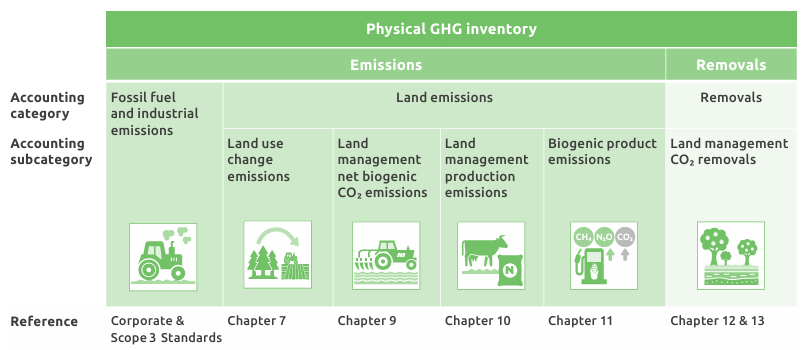
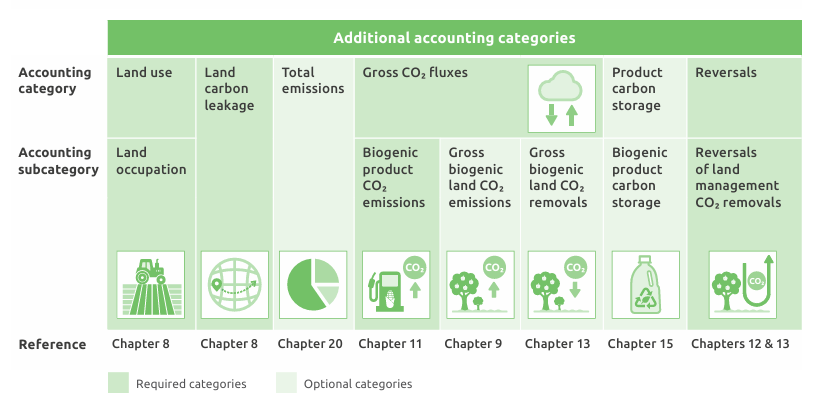
We summarise the main LSRS categories below:
|
LSRS category |
Definition |
|
Land management |
Activities such as harvesting, replanting, and soil tillage occurring on lands that remain within the same land-use category. |
|
Land use change |
The transition from one land-use category to another, such as the conversion of forest land to grassland or cropland. |
|
Land occupation |
A land tracking metric that quantifies the total amount of land area (typically in hectares) required per year to produce or extract the products a company produces or sources. |
|
Land carbon leakage |
The increase in emissions or decrease in removals that occurs outside of a company’s inventory boundary as an unintended result of the company's activities within its boundary. |
|
Biogenic product CO2 emissions |
CO2 emissions resulting from the combustion, biodegradation, or other losses of carbon physically contained in biogenic product carbon pools. |
|
Removals (optional) |
The process of transferring CO2 from the atmosphere to storage within a non-atmospheric pool, such as a land-based product or geologic carbon pool. |
|
Reversals of land management CO2 removals |
A reversal is an emission from a carbon pool that releases carbon associated with a removal previously reported by the company (for example: previously sequestered carbon that is lost due to events like fires, storms, or harvests). |
Top 5 tips to prepare for the LSRS
1. Analyse your existing GHG inventory
Perform a gap analysis based on the LSRS standard:
-
Does your footprint include land management and land use change emissions?
-
Are biogenic and fossil emissions reported separately?
-
Are you using AR6 GWPs with the correct distinction between fossil and biogenic methane?
-
Which activity data is missing to calculate your land emissions?
2. Select the right emission factor databases
For European supply chains, Agribalyse provides a reasonable LUC baseline. For tropical commodities (coffee, cacao, soy, palm), use more granular sources such as WRI or Orbae, which provide land use change factors by commodity and country. The difference can be significant.
3. Map your chain of custody
The LSRS requires physical traceability to the region of origin, which requires an efficient due diligence process. Book-and-claim certificates like renewable energy guarantees of origin are not permitted. Where full traceability isn't yet possible, global average factors apply, typically in a less favourable position. Focus traceability efforts on your highest-emission commodities first.
4. Separate removals from emission reductions
The standard draws a hard line: capturing carbon to reduce net emissions is not the same as removing CO₂ from the atmosphere. Removals are optional under LSRS but mandatory for SBTi FLAG where empirical data exists, and they require continuous monitoring and third-party verification. If you have no removal data yet, account for zero, it's the correct default.
5. Audit your current methodology
Strengthen the accuracy and credibility of your land emissions calculations by having your methodology independently reviewed. A third-party audit can validate your data sources, assumptions, and calculation approach, ensuring they align with recognised standards.
Next steps
The regulatory picture is still evolving, and many emission factor databases are being updated. However, companies need to follow the LSRS guidance to be compliant with the GHG Protocol and thus with CSRD. Auditor scrutiny is also increasing on the topic.
Our advice: don't wait for full clarity before acting. Use databases and tools that are as LSRS-aligned as possible, and build toward compliance step by step. Ensure your most material categories, land use change, and land management are covered first. In a second step, calculate your land occupation and land carbon leakage.
.jpg)