About Eigen Thuis and Möbius
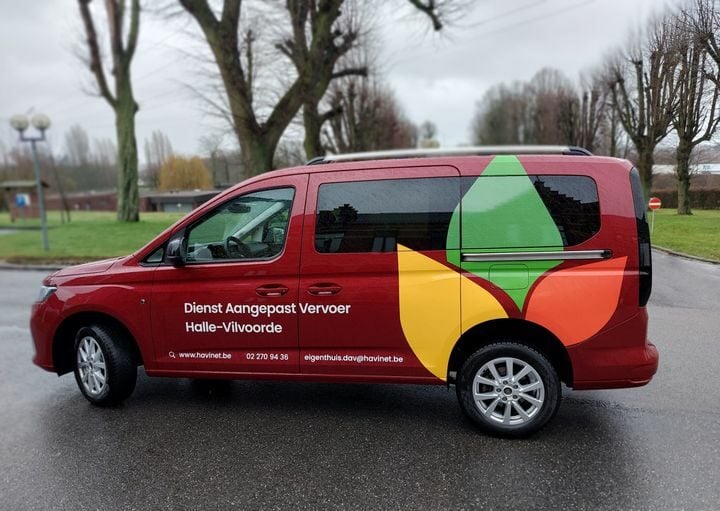
Eigen Thuis (Havinet vzw) is an organisation dedicated to supporting people with disabilities. One of its core services is the Accessible Transport Service (Dienst Aangepast Vervoer – DAV), which has been providing tailored transport solutions for over 40 years to people with (severe) mobility impairments in the Halle-Vilvoorde district. The primary objective of the service is to enhance independence and social participation.
Eigen Thuis and Möbius partnered to future-proof the DAV service while preserving its social mission.
How can accessible transport remain financially and operationally sustainable?
The central question of this project was clear:
How can Eigen Thuis continue to guarantee its Accessible Transport Service while ensuring financial viability in a context of rising costs, changing regulations and an increasingly complex mobility landscape in Flanders?
Why accessible transport is under pressure in Flanders
The Accessible Transport Service plays a crucial role within the care and welfare sector. It provides people with mobility impairments access to care and supports their participation in society.
Despite a strong mission, experienced staff and clear social added value, the organisation faced structural challenges. Rising costs and rapidly evolving mobility policies in Flanders are increasing complexity.
The DAV operates within the framework of the Compensation Decree and is confronted with changes such as the transition to the basic accessibility model and demand-responsive transport (Flexplus). These developments create uncertainty and put pressure on financial and operational sustainability.
The core challenge: how can service continuity be guaranteed while evolving towards a sustainable and future-oriented model?
Approach: financial and operational analysis of accessible transport
Möbius conducted a thorough audit of the DAV Grimbergen operations, inspired by a vision of organisation-wide excellence. This approach combined data analysis, interviews and joint reflection sessions to clearly identify bottlenecks and opportunities.
Insight into data and day-to-day operations
The analysis began with a broad review of the legal framework, the organisation and available data.
Financial data, trip data from planning and tracking systems, and HR information were analysed to determine where value was created and where it was lost.
Interviews with management, planners and drivers provided additional insights into daily operations. Key optimisation levers were identified, including route planning, cancellations, empty runs and waiting times.
In-depth analysis of costs and processes
Operations were further examined through a combination of operational and financial analysis.
Using the Operating Model Canvas, it was mapped how processes, organisation, information and governance collectively create value. This highlighted structural inefficiencies.
In addition, a detailed financial analysis focused on:
- cost per trip
- impact of empty kilometres and waiting times
- effects of cancellations
- ratio between fixed, variable and indirect costs
This integrated approach resulted in a shared understanding of both challenges and strengths.
Future scenarios for sustainable accessible transport
Based on the analysis, four future scenarios were developed, ranging from optimisations within the current model to more fundamental organisational changes.
Each scenario was assessed in terms of financial feasibility, operational impact, organisational implications and alignment with the social mission.
By clearly structuring advantages and disadvantages, Eigen Thuis obtained a solid foundation for strategic decision-making.
Results: from insight to a future-proof operation
The project delivered a clear and shared understanding of the financial and operational performance of the Accessible Transport Service.
Eigen Thuis now has transparent insight into cost structures, loss-making activities and key optimisation opportunities.
Concrete improvement initiatives were also developed and supported by business cases. Both short-term measures, such as more efficient and automated route planning, and long-term levers were financially assessed and weighed against potential risks.
Finally, the project resulted in a forward-looking decision-making framework. DAV Grimbergen now has a realistic pathway towards a more financially robust and professional operation, while maintaining its social mission and accessibility.