Imagine your manager asks you tomorrow to reduce operating costs by 10%. What would your response be? Many organisations immediately turn to a new AI tool. Yet that is precisely the wrong first step. Technology only delivers a return when you first understand where your time and money are currently being spent. AI that generates real value does not start with technology. It starts with the work itself.
Watch the recording of the ‘The Process Shift’ webinar now at your own pace.
Lots of AI, little return
AI is everywhere these days. 76% of large Belgian companies are already using some form of AI. And yet, 95% of those pilot projects yield no measurable return. That’s a striking gap. It shows that the challenge isn’t in purchasing impressive technology, but in turning it into real value.
Those who start with a tool right away often build a solution without knowing exactly what problem it solves. The benefit isn’t in the technology itself, but in where and how you use it.
Three questions, in the right order
A successful AI transformation follows three questions — and the sequence matters.
Where is the work?
Which work can AI take on?
How should we bring it in?
Only once you have answered the first question does the second become meaningful. And only then can the third be addressed effectively.
Three steps towards results
1. Assess: Where is the work?
Start by measuring before you even think about a tool. For each department and role, identify the tasks people perform, how much time each task requires and how frequently it occurs. This will reveal where the real workload lies. Importantly, frame the discussion around freeing up time rather than eliminating jobs. The goal is to redeploy capacity where it creates greater value. Two considerations are particularly important. First, support employees in estimating their workload. People tend to overestimate the time spent on complex tasks or tasks they have completed recently. Second, validate the figures against reality. This creates a reliable foundation and a robust business case.
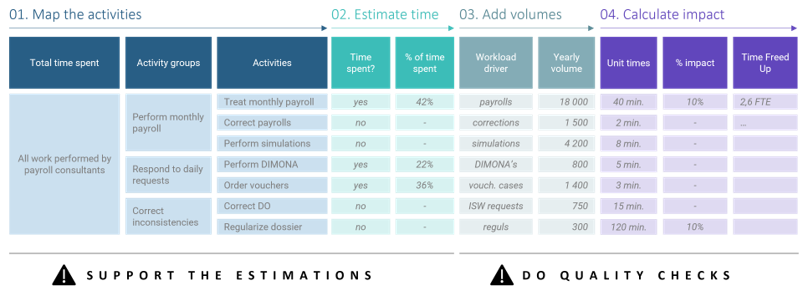
From mapping tasks to identifying freed-up time: an example of a workload analysis for a payroll team.
2. Filter: Which tasks can AI handle?
Not every task is suitable for AI. Before you invest, run your shortlist through three filters.
- Is the data available? AI can only work with information it actually has access to. The data must exist, be digitally accessible, and not be buried in someone’s head, scattered across individual email inboxes, or trapped in an outdated system that doesn’t communicate with the outside world. If that foundation is missing, that’s often your first area to address—even before AI comes into play.
- Is there enough volume and repetition? AI is only worthwhile when a task recurs frequently and in a similar form—think of hundreds or thousands of similar cases per year. A process that unfolds differently each time or occurs only occasionally rarely yields enough value to justify the investment. The more predictable and repetitive the process, the greater the benefit.
- Is the margin of error manageable? AI—and certainly generative AI—is never 100% accurate. So the question isn’t whether there will be errors, but how much risk an error entails and how you mitigate it. For tasks with little impact, AI can safely operate autonomously. Where an error is costly or sensitive, you build in checks: smart process design and human validation at the right moments. This way, the time savings are maintained without compromising quality.
Consider the anonymization of thousands of documents: high volume, available data, and a human reviewing cases of doubt. In such repetitive processes, AI often achieves even higher accuracy than a human. Möbius applied this principle at a government organization that anonymizes documents on a large scale.
3. Decide: Buy or Build?
Finally, the choice between buying and building it yourself. Almost all of our projects today are hybrid: you buy the building blocks and build the orchestration on top of them yourself. It’s best to buy the underlying AI models, such as large language models (LLMs), off-the-shelf. Developing them yourself costs a fortune, and by purchasing them, you’re always working with the latest technology without the burden of heavy maintenance.
The real added value lies in the orchestration you build on top of them: the layer that controls everything and aligns it with your processes. Think of it as the conductor of the AI orchestra. It directs various AI technologies, grants them secure access to your business data, and ensures they work together in the correct sequence. So the market provides the raw computing power; your orchestration turns it into a working process. Weigh the choice between buying and building based on factors such as the desired fit, strategic importance, market availability, data security, time to results, and your ability to maintain it.
Start with the work, not the tool
An AI transformation is not a one-off project. It is an ongoing process of refinement. If you are asked to achieve significant savings, do not skip the first step. Measure where the work resides, identify which activities AI can genuinely support and combine purchased technology with your own orchestration capabilities. The organisations that stand out are not those with the greatest number of tools. They are the ones that truly understand their processes before introducing technology.
So do not start with the technology. Start with the work — and build from there.